How Affiliate Sites With AI Are Changing the Passive Income Game
Building an affiliate site used to mean writing dozens of product reviews by hand, waiting months for Google to notice you, and praying that a few links turned into commissions. I did it the old way for years. Then I started testing what happens when you let AI handle the heavy lifting. The results were not instant, but they were real. Now I want to walk through what actually works, what does not, and where the smart money is going.
Why the Old Model Broke
Affiliate marketing always had a low barrier to entry, but that also meant everyone and their cousin was doing it. You would set up a Blogspot site, join Amazon Associates, and start grinding out content. If you were lucky, a ShareASale merchant would let you promote their tools. But the math was brutal. Writing a 2000-word review took half a day. If the article ranked, you might earn thirty bucks a month. If it did not, you earned zero. Most people quit within six months.
The problem was not the model. It was the volume you needed to hit before anything compounded. You needed dozens of articles, backlinks, and a steady stream of updates. That is where affiliate sites with AI started to change things. Instead of spending hours on each post, I could outline a topic, feed it into a tool like Jasper AI or Copysmith, and get a solid first draft in minutes. Then I edited for voice, added my own experience, and published. The speed difference was dramatic.
What AI Actually Does Well
Let me be honest about the limits. AI is not a magic wand. You cannot feed it a keyword and expect a perfect article that ranks immediately. But for certain tasks, it is incredibly good. Writing product roundups, comparison tables, and listicles that follow a clear structure is where tools like ChatGPT and Jasper AI shine. They produce clean, readable text that needs only light editing to sound human.
I have also used Midjourney and Canva to create visual assets. Instead of licensing stock photos or hiring a designer, I generate custom images that match the tone of the site. That saves both time and money. And when I need to optimize the content for Google SEO, I run it through RankMath and SEMrush to check keyword density, readability, and internal linking opportunities. The combination of AI generation and SEO tools is what makes affiliate sites with AI viable for someone who does not have a team of writers.
Setting Up the Technical Foundation
Before you write a single word, you need a solid technical base. I recommend a managed WordPress host like Kinsta. Their speed and uptime matter for Google rankings. From there, use a plugin like AffiliateWP to manage your links and commissions. It integrates cleanly with WooCommerce if you ever sell your own products, but for pure affiliate work, it keeps everything organized.

Email is still a huge part of affiliate income. I use AWeber for my lists, but any email service will work. The key is to capture leads early. Give away a free guide or a checklist in exchange for an email address. Then send useful content, not just affiliate links. That builds trust, and trust converts better than any link ever could.
Choosing the Right Programs
Not all affiliate programs are equal. Amazon Associates is the biggest, but the commissions are small and the cookie window is short. For higher payouts, look at ShareASale and ClickBank. Digital products often pay 50% or more per sale. Physical goods pay less but can have higher volume. I have found that promoting software tools through ClickBank works well because the content stays relevant longer. A review of a tool like Builderall or Copysmith can earn commissions for years if it ranks well.
One mistake I made early was joining too many programs at once. You end up with a scattered site that promotes everything and convinces nobody. Better to pick two or three programs and build deep content around their products. If you promote WooCommerce themes, for example, write ten articles about different use cases. Google sees the topical authority and rewards you with higher rankings.
The Workflow That Works
Here is the process I follow now. It balances speed with quality, and it keeps me from burning out.
- Keyword research with Ahrefs or SEMrush to find terms that have decent search volume but low competition.
- Outline the article by hand. I write the subheadings and note the key points I want to cover. This is where human judgment matters most.
- Generate a draft using ChatGPT or Jasper AI. I feed it the outline and ask for a 1000-word article in a conversational tone.
- Edit heavily. I cut fluff, add personal anecdotes, check facts, and rewrite any sentences that sound robotic.
- Run the final text through RankMath for on-page SEO. I adjust the title, meta description, and heading tags.
- Publish and share on social media. I also send the article to my AWeber list.
That whole cycle takes me about two to three hours per article. That is down from six to eight hours when I wrote everything from scratch. Over a month, I can produce three times the content without sacrificing quality.
Where AI Still Falls Short
I want to be clear about the downsides. AI-generated content often lacks depth. It can describe a product feature, but it cannot tell you how that feature feels in real use. It cannot share the frustration of a plugin that breaks your site or the joy of a tool that saves you an hour a day. That lived experience is what readers trust. If you publish only AI text with no human insight, your bounce rate will climb and your conversions will drop.
Another issue is originality. AI models are trained on existing content, so they tend to produce variations of what is already out there. To stand out, you have to inject your own perspective. I always rewrite the opening and closing paragraphs by hand. Those are the parts that hook readers and leave a lasting impression.
Google SEO is also getting smarter at detecting shallow content. The old trick of publishing hundreds of low-effort articles no longer works. Google Analytics will show you that thin pages get zero traffic after the initial crawl. The sites that survive are the ones that combine AI efficiency with genuine expertise. That is the sweet spot.
Scaling Without Losing Your Mind
Once you have a working workflow, the next step is scaling. You can outsource the editing part to a freelance writer, but keep the research and outlining in your hands. That way you maintain control over the voice and direction. Some people use Builderall to build entire site networks, but I prefer a single site with deep content. It is easier to manage and ranks better over time.
Monetization also scales. Beyond affiliate commissions, you can create your own digital products. If you build an audience around affiliate sites with AI, you can sell a course or a template pack. That income is not dependent on a merchant changing their terms. It belongs to you.
Tools I Rely On Every Day
Here is my current stack. It changes as new tools appear, but these have stuck around for at least a year.
- Ahrefs for keyword research and competitor analysis.
- Jasper AI for drafting content.
- Canva for social media graphics and featured images.
- RankMath for on-page SEO optimization.
- AWeber for email marketing.
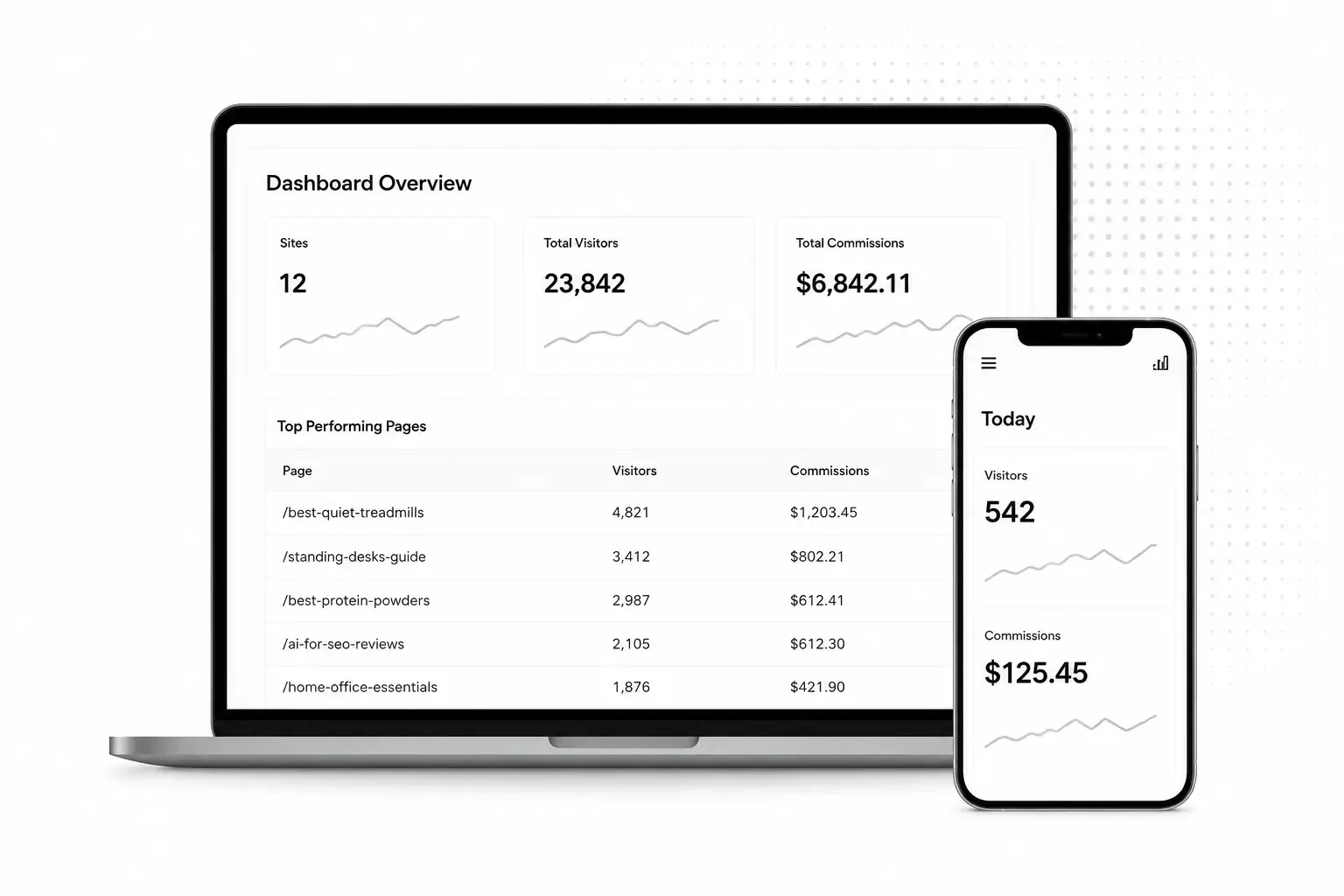
I also use Google Analytics daily to see which articles are getting traffic and where people drop off. That data feeds back into my content plan. If a page has high traffic but low conversions, I rewrite the call to action or add a comparison table. Small tweaks can double your income without writing a single new article.

The Bottom Line
Affiliate marketing is not dead, but the old methods are too slow for most people. Using AI to accelerate content production changes the math. You can build a profitable site on a part-time schedule if you focus on quality and authenticity. The phrase affiliate sites with ai gets searched because people sense the opportunity. They are right to be curious. The technology works, but only if you treat it as a tool, not a replacement for your own judgment.
Start small. Pick one program, one keyword, and one article. Write it, edit it, and publish it. Then do it again. Over six months, you will have a library of content that earns while you sleep. That is the real promise of this approach. It is not about getting rich overnight. It is about building something that compounds over time.